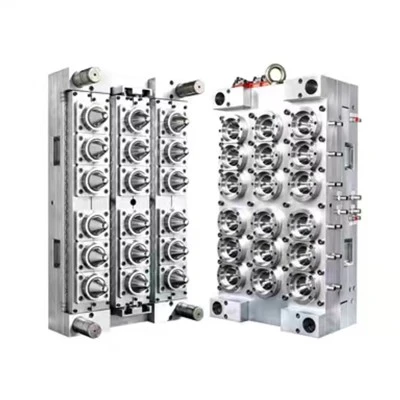
When PET plastic is injected into a round trash can mold, air and volatiles in the high-temperature melt seek an outlet like compressed balloons. If the mold lacks a venting system, these gases can form bubbles, silver streaks, or scorch marks on the product surface, similar to overflowing porridge if the lid isn't turned off. Edge venting (mold parting surface venting) acts as a 'breathing valve' for PET trash can molds. By machining venting grooves 0.03-0.05mm deep on the parting surface, gases can escape smoothly without affecting the product's appearance. However, not all locations require edge venting-it should be avoided on the product's surface, prioritizing areas where the melt is last filled or where wall thickness changes abruptly.
Location Selection: Venting grooves should be located at the end of the melt flow or in areas where gas is trapped. For example, the base of reinforcing ribs and bottom corners of a round trash can mold are prone to forming gas stagnation zones. Simulation software can be used to analyze the melt filling process and pinpoint gas accumulation points.
Structural Optimization: Edge venting grooves can be designed as trapezoidal or semi-circular, 3-5mm wide, with a depth controlled within 0.03mm (too deep will cause burrs). For large trash can molds, a vacuum suction device can be added to the end of the venting groove, like equipping the mold with an "exhaust fan".
Depth Control: Use a feeler gauge to check the depth of the venting groove. A groove of 0.03mm can expel gas without leaking glue. If flash appears on the surface of the product, it indicates that the venting groove is too deep; if air bubbles still appear, the groove needs to be deepened or additional venting points added.
Basic Version: A single venting groove is machined on the parting surface, suitable for small trash can molds.
Advanced Version: Uses a "main groove + branch groove" structure. The main groove runs through the entire air trapping zone, and the branch grooves disperse and guide the gas, as efficient as a city drainage system.
Ideal Version: Combining mold flow analysis, a breathable steel (such as PM-35) is inserted into the mold core. This material is filled with micropores, allowing gas to pass through but preventing plastic from seeping in, suitable for complex trash can mold structures.