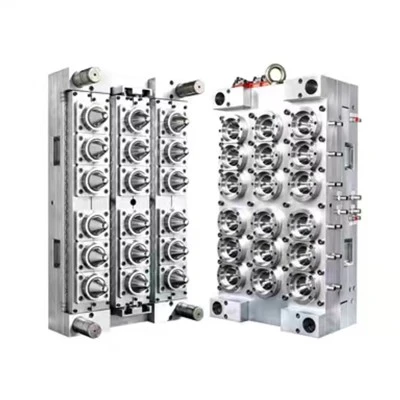
There's a trick to runner design. Plug PET material into the mold like pouring molten chocolate into a mold, and the runner is the key straw. To ensure smooth and unblocked PET material flow:
Use fan-shaped or trapezoidal runners, with a recommended width of 8-12mm.
The ideal angle between the main runner and branch runners is 60°.
Set the inlet thickness to 50%-70% of the product wall thickness.
The cold slug well depth should be no less than 1.5 times the runner diameter.
PET is more sensitive to temperature than a barista; improper temperature control can lead to crystallization and white fog:
Barrel temperature: 260-280℃ in stages, nozzle temperature 5℃ lower.
Mold temperature: 80-120℃ is ideal; below 60℃, cold slug marks are likely to appear.
Insulation tips: Control the mold temperature controller temperature difference within ±2℃.
The often-overlooked venting system is actually a quality gatekeeper:
Ventilation groove depth 0.02-0.04mm, width 5-8mm.
At least one venting point per 100mm².
Ejector pin venting is 30% more efficient than insert venting.
Observe the weld line position during trial molding and adjust the venting accordingly.